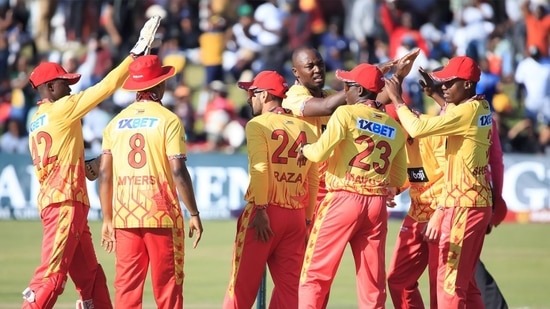
India's Batting Blitz: A Record-Breaking Display Against Zimbabwe in T20 World Cup Super 8
In a breathtaking display of power-hitting, Team India unleashed an unprecedented batting assault against Zimbabwe in the ICC Men's T20 World Cup Super 8 clash held at the MA Chidambaram Stadium in Chennai. Electing to field after winning the toss, Zimbabwe found themselves facing a relentless Indian lineup that piled on a colossal 256 for 4 in their allotted 20 overs. This monumental total has set a daunting challenge for Zimbabwe, fundamentally shaping the india vs zimbabwe scorecard and putting India firmly in control of this crucial Super 8 encounter.
The Chepauk crowd witnessed fireworks from the very first over, as Indian batsmen launched an all-out offensive, showcasing their depth and aggressive intent. The 256/4 stands as a testament to their exceptional form and perhaps one of the highest totals ever recorded by India in T20 World Cup history, a true spectacle that will be remembered in the annals of T20 cricket.
India's Dominant Innings: A Symphony of Sixes and Fours
From the moment the first ball was bowled, India’s intent was clear: to dominate. The innings was a masterclass in aggressive batting, with almost every batsman contributing significantly at an astounding strike rate. While Sanju Samson (24 off 15 balls, SR 160.00) provided a brisk start, it was Abhishek Sharma who truly set the tone with a brilliant half-century. Sharma, opening the innings, scored a dynamic 55 runs off just 30 balls, studded with 4 fours and 4 sixes, achieving a strike rate of 183.33. His fearless approach laid a solid foundation for the middle order.
Ishan Kishan, coming in at number three, continued the onslaught with a quickfire 38 off 24 balls (4 fours, 1 six, SR 158.33). Even after a couple of wickets fell, the scoring rate never dipped. Captain Suryakumar Yadav, known for his audacious 360-degree strokeplay, provided a crucial impetus with a rapid 33 runs off just 13 balls, including 3 fours and 2 sixes, boasting an incredible strike rate of 253.85. His departure at 172 for 4 in the 14.5th over, however, only paved the way for another explosive partnership.
The real highlight of India's innings came from the sensational unbeaten stand between Hardik Pandya and Tilak Varma. Pandya, the vice-captain, demonstrated his all-round prowess, smashing an unbeaten 50 runs off just 23 balls, featuring 2 fours and 4 sixes, at a blistering strike rate of 217.39. Not to be outdone, young Tilak Varma played a breathtaking cameo, remaining unbeaten on 44 runs off a mere 16 balls, adorned with 3 fours and 4 sixes, achieving an astonishing strike rate of 275.00. Together, their partnership provided the late surge that propelled India past the 250-run mark, leaving the Zimbabwean bowlers visibly rattled.
Zimbabwe's bowling attack struggled to contain the Indian batsmen on a pitch that offered little assistance. Richard Ngarava (1 wicket for 62 runs from 4 overs) and Tinotenda Maposa (1 wicket for 40 runs from 2 overs) were particularly expensive, highlighting the immense pressure they were under. Even Sikandar Raza managed to pick up a wicket but conceded 29 runs in his 3 overs. The 12 extras, including 7 wides and 1 no-ball, further compounded Zimbabwe's woes, underscoring the lack of discipline in their bowling effort. For a deeper dive into this incredible batting display, read more about Pandya, Tilak Fifties Power India to Record 256 vs ZIM.
Zimbabwe's Valiant Chase: An Uphill Battle
Chasing a mammoth target of 257 runs, Zimbabwe faced an almost impossible task from the outset. Despite the enormous pressure, they showed glimpses of resilience. At the time of this report, Zimbabwe stands at 137 for 2 after 15.1 overs, with an improbable 120 runs still needed from just 4.5 overs (29 balls) with 8 wickets in hand. The required run rate has soared to an astronomical level, making a victory highly unlikely.
The innings saw a promising start from opener Bennett, who has been the anchor of Zimbabwe's chase. Bennett played a magnificent knock, currently unbeaten on 78 runs off 48 balls, including 6 fours and 5 sixes, striking at 162.50. His aggressive intent, despite the wickets falling around him, is commendable. Tadiwanashe Marumani (20 off 20 balls) and Dion Myers (6 off 9 balls) provided brief support but couldn't convert their starts into significant scores, falling to Axar Patel and Varun Chakaravarthy, respectively.
Skipper Sikandar Raza has joined Bennett at the crease and is currently batting on 25 runs off 15 balls, showing his class with 1 four and 2 sixes. However, even with these strong individual performances, the sheer magnitude of the target has proven to be overwhelming. India's bowlers, despite the high-scoring nature of the match, have largely kept a tight leash on the run rate, with Hardik Pandya (2 overs, 12 runs) and Jasprit Bumrah (3 overs, 21 runs) maintaining decent economy rates in the initial phase. Varun Chakaravarthy picked up one wicket conceding 29 runs in 3.1 overs, while Axar Patel claimed one wicket for 35 runs in his 4 overs. Shivam Dube, bowling a single over, proved expensive, conceding 26 runs, highlighting the risk of part-time bowlers in high-pressure situations. The question remains: Zimbabwe Chasing 257 vs India: Can They Pull Off a Miracle? Given the current scoreboard, the answer appears to be a resounding no.
Tactical Decisions and Pitch Dynamics
The toss played a pivotal role in this encounter. Zimbabwe’s decision to field first at the MA Chidambaram Stadium, a venue known for its flat tracks and historical support for spinners, might have backfired significantly. While there might have been an expectation of dew later in the evening, the pitch offered minimal assistance to the bowlers upfront, allowing India's batsmen to exploit the conditions perfectly. The high economy rates of Zimbabwe’s frontline bowlers – Ngarava (15.50), Maposa (20.00), and Evans (13.00) – illustrate just how challenging it was for them to contain the rampant Indian batting lineup.
Conversely, India's strategy to bat aggressively from ball one paid rich dividends. Their batting depth, with players like Shivam Dube, Axar Patel, and even tail-enders like Jasprit Bumrah still to bat, instilled confidence. The captaincy of Suryakumar Yadav was also noteworthy, as he marshalled his resources effectively during Zimbabwe’s chase, utilising his bowlers to pick up crucial wickets and maintain pressure, despite the odd expensive over. The early wickets taken by Axar Patel and Varun Chakaravarthy were vital in curbing Zimbabwe's momentum and reinforcing India's dominance.
What This Scorecard Means for India's T20 World Cup Campaign
This comprehensive performance in Chennai sends a powerful message to all other contenders in the ICC Men's T20 World Cup Super 8. India's massive total of 256/4 not only showcases their immense batting strength and depth but also significantly boosts their net run rate (NRR), which could prove crucial in the later stages of the tournament. A dominant victory here will solidify India's position at the top of their Super 8 group, paving a clearer path to the semi-finals.
For Zimbabwe, while the chase proved too steep, the individual brilliance of Bennett provides a silver lining. However, the overall performance underscores the gap between the two teams and the need for significant improvements in their bowling attack, particularly in handling high-pressure situations against top-tier batting lineups. The india vs zimbabwe scorecard from this match will undoubtedly be analyzed closely by both teams, offering valuable insights into their strengths and areas for development as the tournament progresses.
In conclusion, India's commanding batting display, culminating in a staggering 256 for 4, has emphatically tilted the scales in their favour in this Super 8 clash against Zimbabwe. While Zimbabwe fought valiantly, the sheer momentum generated by India's batsmen proved insurmountable. This match highlights India's formidable presence in the T20 World Cup, as they continue their quest for the coveted trophy with authority and aggressive intent.